





Vehicles and instrumented buoys, transforming remote maritime platforms into persistent detection, identification and monitoring nodes.
Deployed close to the sensors, SEASARS Edge can integrate maritime radar, AIS, EO/IR cameras, acoustic sensors, weather instruments and platform navigation data. It processes relevant information locally and transmits an optimised operational picture to a remote control station or command centre.
Designed for constrained environments where payload, electrical power and communication bandwidth are limited, the solution supports persistent offshore surveillance, critical infrastructure protection, border security, environmental monitoring and maritime ISR missions.
What missions can be performed using a SEASARS-equipped USV or instrumented buoy?
SEASARS-equipped USVs and instrumented buoys can support persistent maritime surveillance in areas where conventional manned patrols or fixed coastal stations may be difficult, costly or operationally constrained.
Typical missions include:
- Maritime Intelligence, Surveillance and Reconnaissance
- Coastal and offshore surveillance
- Critical infrastructure protection
- Offshore platform and wind farm monitoring
- Border and maritime law-enforcement support
- Detection of illegal trafficking and unauthorised activity
- Fisheries protection
- Search and Rescue support
- Temporary surveillance of remote maritime areas
- Forward deployment of radar and electro-optical sensors
A USV provides a mobile surveillance capability that can patrol or reposition according to the mission. An instrumented buoy provides a persistent observation point for long-duration monitoring of a defined area.
How does SEASARS operate at the Edge?
SEASARS Edge is deployed onboard the USV or buoy, close to the connected sensors.
Instead of transmitting every raw sensor stream continuously, the system can process radar detections, tracks, AIS reports, camera information and platform data locally. Relevant tracks, alerts, images and system-status information can then be transmitted to the remote operator.
This Edge architecture provides several operational advantages:
- Faster local processing of sensor data
- Continued sensor operation during temporary communication interruptions
- Transmission of mission-relevant information rather than unnecessary raw data
- Scalable connection of several remote platforms to one command centre
The precise balance between local processing and remote transmission can be adapted to the available communication link and mission requirements.
Which sensors can be integrated on a USV or smart buoy?
The sensor package can be adapted to the platform, mission, payload capacity and available electrical power.
Typical sensors may include:
- Compact maritime surveillance radar
- AIS receiver or transceiver
- Day and infrared electro-optical cameras
- Acoustic and underwater detection sensors
- ADS-B receivers
- Remote Identification receivers
- Weather and oceanographic sensors
- GNSS positioning equipment
- Heading, attitude and motion sensors
- Communication and radio-direction-finding equipment
- Environmental and pollution-monitoring sensors
SEASARS consolidates the available information into a common operational picture.
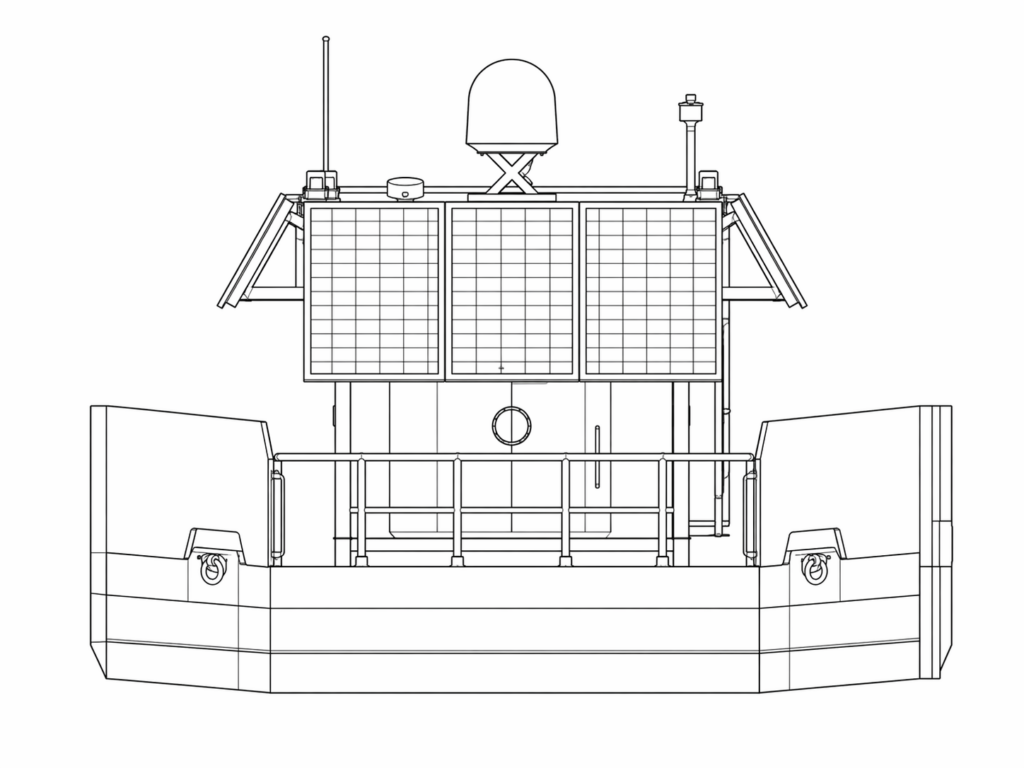
DCMS has already implemented this type of compact radar and mission-system architecture on uncrewed platform and on instrumented buoy.
How are remote platforms supervised from a command centre?
SEASARS can transmit the operational picture generated onboard the platform to a remote control station or command centre.
Depending on the system configuration and available communications, operators may receive:
- Radar tracks and selected radar information
- AIS contacts and vessel identities
- EO/IR images or video
- Sensor alarms and operational alerts
- Platform position and heading
- Sensor and communication status
- Recorded mission data
- Track histories and target behaviour
- Environmental measurements
Several USVs, buoys, coastal stations or other sensor platforms can be displayed within the same SEASARS operational environment.
SEASARS manages the surveillance sensors and mission information.
What are the respective advantages of a USV and an instrumented buoy?
USVs and instrumented buoys provide complementary surveillance capabilities.
A USV offers:
- Mobility and mission-area repositioning
- Patrol of extended or changing surveillance zones
- Closer investigation of detected targets
- Deployment of several complementary sensors
- Support for dynamic ISR and maritime-security missions
An instrumented buoy offers:
- Persistent surveillance of a defined area
- Long-duration autonomous deployment
- Reduced operating and maintenance requirements
- Monitoring close to offshore infrastructure
- Creation of a fixed offshore detection point without building a conventional station
Both platform types can be connected to the same SEASARS command architecture. A distributed network combining mobile USVs, persistent buoys and coastal sensors can provide broader coverage and greater resilience than a single surveillance platform.
Additional information
Interested in this product?
Download the datasheet or request a demo.
-
90 rue Ernest Hemingway